7 Unconfounded Treatment Assignment & Estimating Propensity Score
Randomized Experiments and Observational Studies
Randomized Experiments
A randomized experiment is an assignment mechanism that
- is probabilistic and
- has a known functional form that is controlled by the researcher
And there are a special case of randomized experiment called classical randomized experiment whose assignment mechanism is
- individualistic, and
- unconfounded
Four important special cases:
- Bernoulli trials
- Complete randomized experiments
- Stratified randomized experiments
- Paired randomized experiments
Observational Studies
An observational study is an assignment mechanism if the functional form of the assignment mechanism is unknown.
Two categories: Regular Assignment Mechanism and Irregular Assignment Mechanism.
An assignment mechanism is regular if it is
- individualistic
- probabilistic
- unconfounded
Introduce the Irregular Assignment Mechanism briefly here.
- Assignment to treatment may differ for some units from the receipt of treatment, i.e., noncompliance.
- We often assume that assignment to treatment itself is unconfounded, but allow receipt of treatment to be confounded.
Caution
Unconfoundedness Is Not Testable. There is no information in the data that can tell us that unconfoundedness does not hold, even in settings with a large number of units.
RAMs vs SREs
Common features:
- Base inference on strata defined by covariates .
- Stratum-level causal effects are identifiable & estimable.

Key differences
- are known in SREs.
- But unknown in a RAM.
RAM can be treated as SREs with unknown propensity score in each stratum. The textbook says:
The fact that we do not know a priori the probability of assignment to the treatment is irrelevant here: we can use the results for the analysis of completely randomized experiments by conditioning on the number of treated women and treated men. (Textbook p259)
Just see the finite sample expectation of . Let
then the finite sample expectation
The fact that is not obvious. The second part of the individualistic assignment is the core (refer here).
Since we don't know the propensity score, we want to estimate them. Note that in a RAM
so we can use the sample mean of , which is , to estimate it. This is guaranteed by LLN (the version that allows dependency).
Then here comes the problem. If can take many values, then in each stratum, the sample size would be rather small. So balancing score is introduced.
Balancing Score and Propensity Score
Concepts
Definition (Balancing Scores)
A balancing score is a function of the covariates such that .
Lemma (Unconfoundedness Given a Balancing Score)
Suppose assignment to treatment is unconfounded. Then assignment is unconfounded given any balancing score:
The proof is as follows:
Let
Then
Lemma (Balancing Property of Propensity Score)
The propensity score is a balancing score.
On one hand,
On the other hand
So
thus
Back to the main topic. We want to reduce the number of strata, so should take less possible values, i.e. the coarser the better.
How to define coarseness? We know a mapping usually loses information. So if , where is not injection (单射), then we say is coarser.
What is the coarsest balancing score? The propensity score has this good property.
Lemma (Coarseness of Balancing Scores)
The propensity score is the coarsest balancing score.
Suppose is not the coarsest. Then there exist and , such that
But we have
It is contradictory!
Methods for Estimation in RAMs
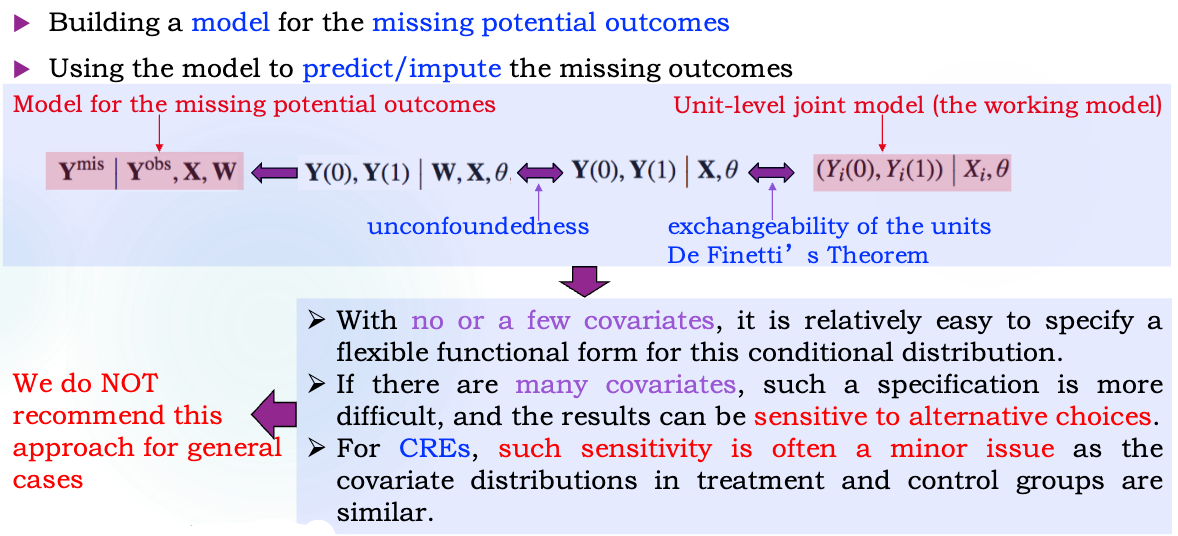
Imputation
The core of the model-based method and the regression method is to predict the counter-factual potential outcomes and use the predicted results to estimate the ATE.
Model-Based Method
Regression Method
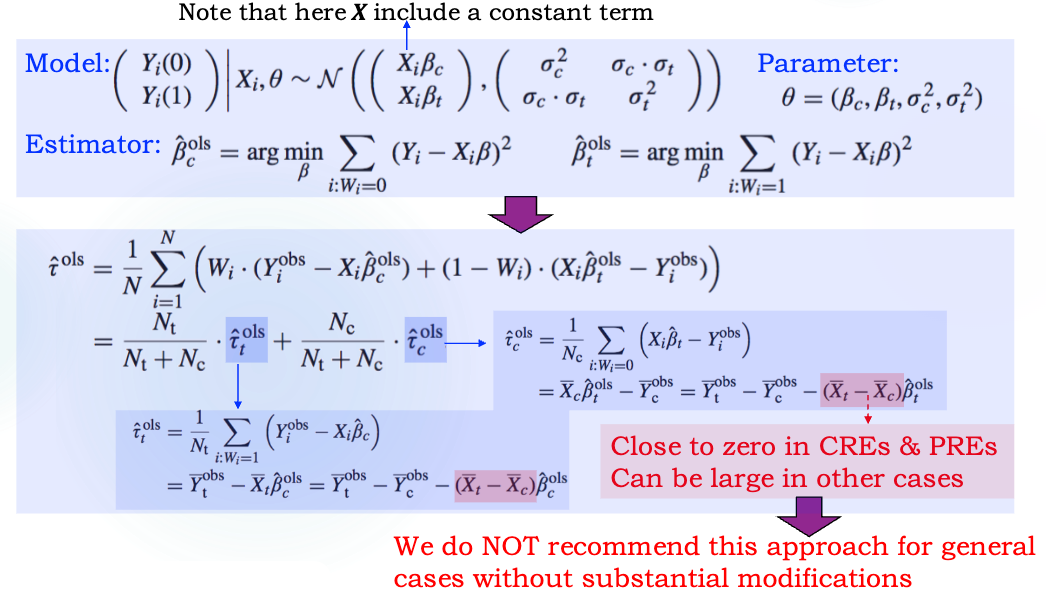
Summary of Imputation Methods
The two methods are not recommended in RAMs because of the systematical difference of the distribution of the covariates between the treated and the controlled groups. The predictions are not very trustable. Consider the setting: a model is trained on the data of males but is used to predict females.
Balance the Covariates
Weighting Estimators
Can show that
and
So we can use
to estimate the ATE.
But in practice we don't know the propensity score, so we have to estimate it. Later we will talk about how to estimate it.
Blocking Estimators
A more robust approach involving the propensity score is to coarsen it through blocking (i.e., subclassification). In this third approach, the sample is partitioned into subclasses, based on the value of the estimated propensity score. Within each subclass, the data can be analyzed as if they arose from a completely randomized experiment. (Textbook p274)
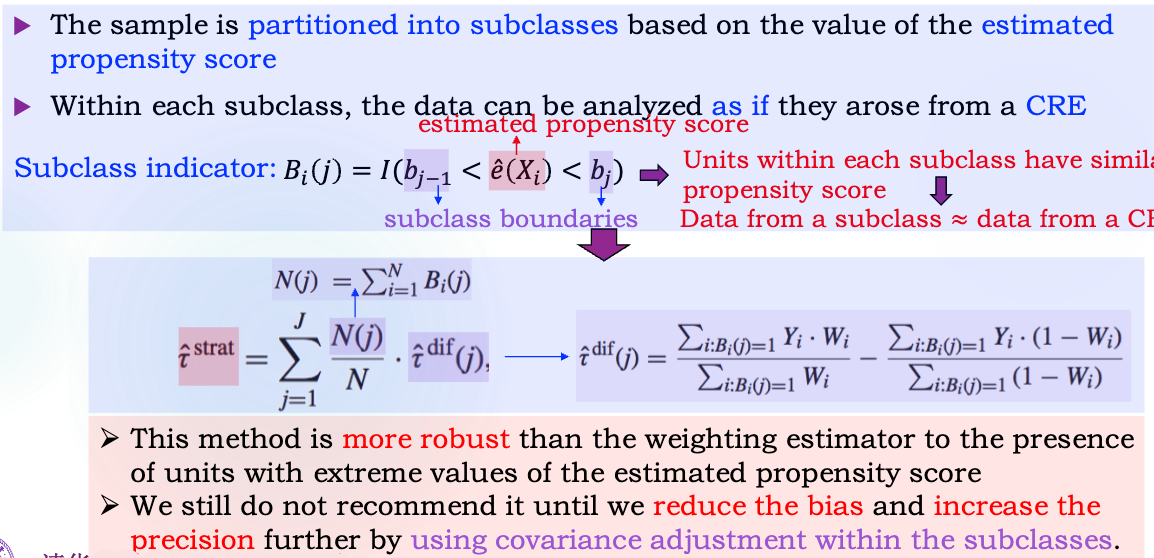
The estimator comes with issues of bias.
In particular, we recommend reducing the bias and increasing the precision further by using covariance adjustment within the subclasses. (Textbook p275)
Matching Estimators
... it relies on finding direct comparisons, that is, matches, for each unit. For a given treated unit with a particular set of values for the covariates, one looks for a control unit with as similar a set of covariates as possible. (Textbook p275)
Estimating Propensity Score
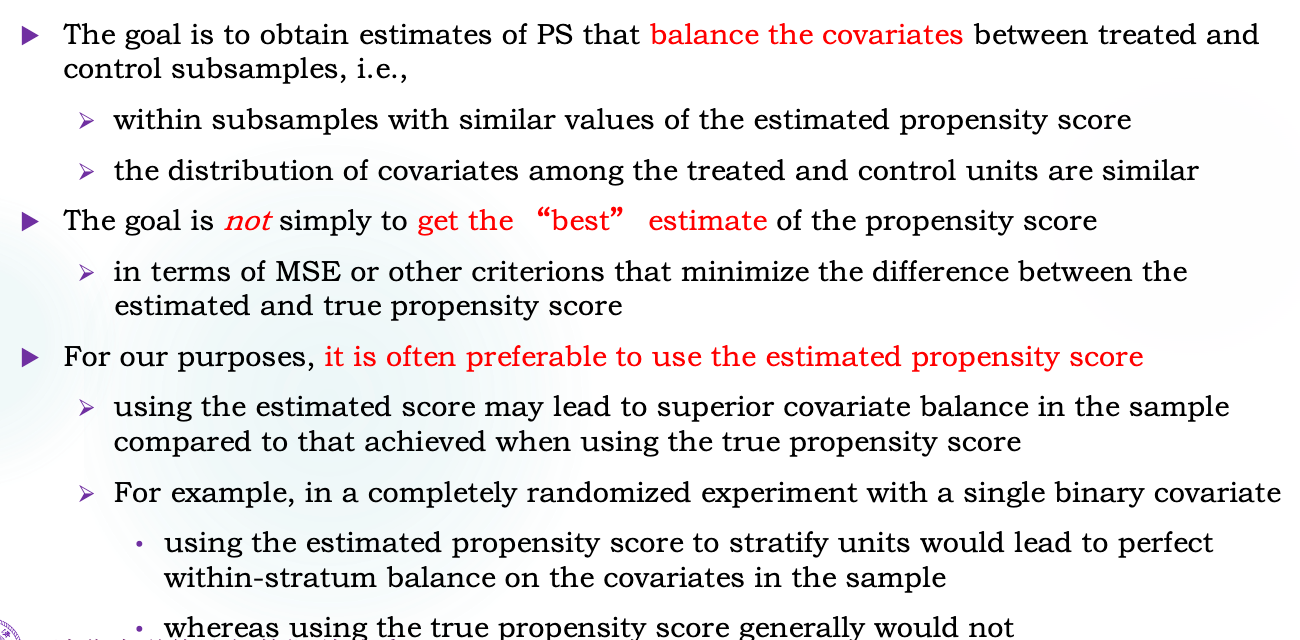
Does the estimation accuracy matter?
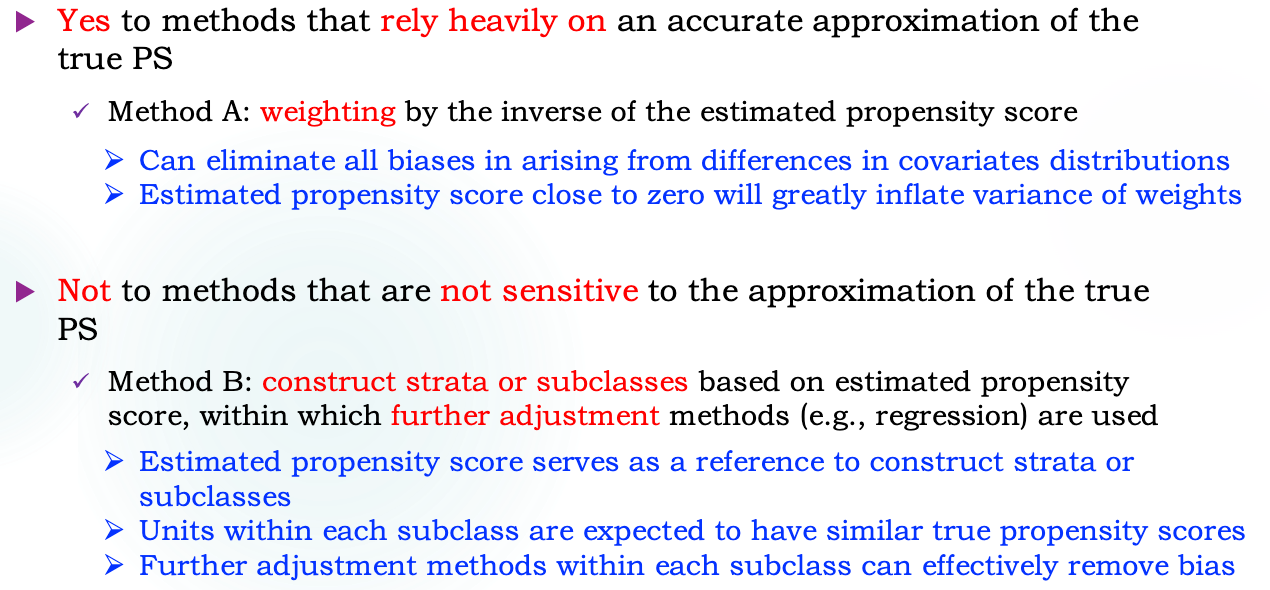
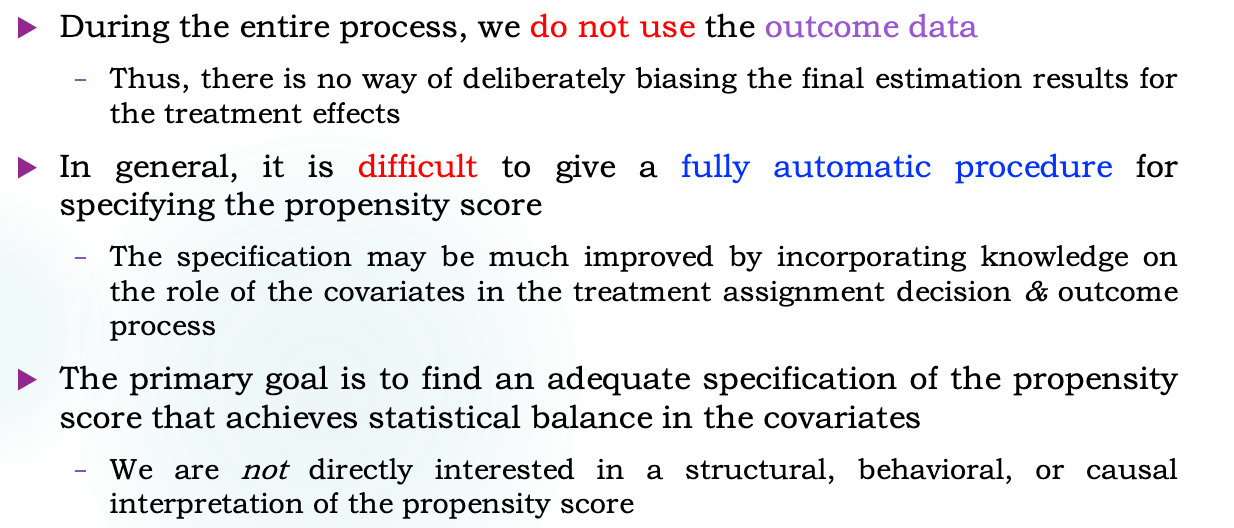
Be clear about the goal.
用估计的 PS,估计量的统计性质不会被破坏吗?比如无偏性啥的。
Three comments:
- 只看满足分配假设的观察性研究
- 观察性研究中,、 等有随机性,或者说未知,propensity score 无法计算,需要估计
- 取值很多,或者是个向量,分层会分得很细,样本量少,propensity score 估计不准确,需要 bs
- balancing score
- given bs still unconfounded
- why named like this?
- the propensity score is a bs
- ps is the coarsest. 映射会丢失信息,故若能表示为某 bs 的映射,即为更粗
- 观察性研究
- 贝叶斯方法,不推荐,对模型假设敏感,若 取值多,往往不准
- 回归法,不推荐
- Weighting estimators, unbiased
- Blocking estimators
- matching estimators
- 估计 PS