1 Intro And Neyman-Rubin Framework
Intro
两种关系
- 因果作用:探究 A 影响 B 与否,如何影响。Neyman-Rubin 框架。
- 因果关系:从众多变量中寻找因果关系。Pearl 的因果图。
Data Collection
- observational,不做干预
- experimental
The Neyman-Rubin Framework
Basic Concepts
Causality is tied to an action applied to a unit.
Actions: treatment and control
Each action-unit pair is associated with a potential outcome.
- We can see a potential outcome as a mapping defined on the actions towards an unit.
The causal effect of one action relative to another involves comparison:
Any causal statement must clearly define the elements above, or it's informal. See the examples below:
- "She got a good job last year because she went to college"
- unit: she
- treatment: go to college
- control: not go to college. Note that the potential outcome associated with this action is not well defined. She could have enrolled in the military or found no job and each of the conditions has different potential outcome.
SUTVA
The basic challenge of causal inference.
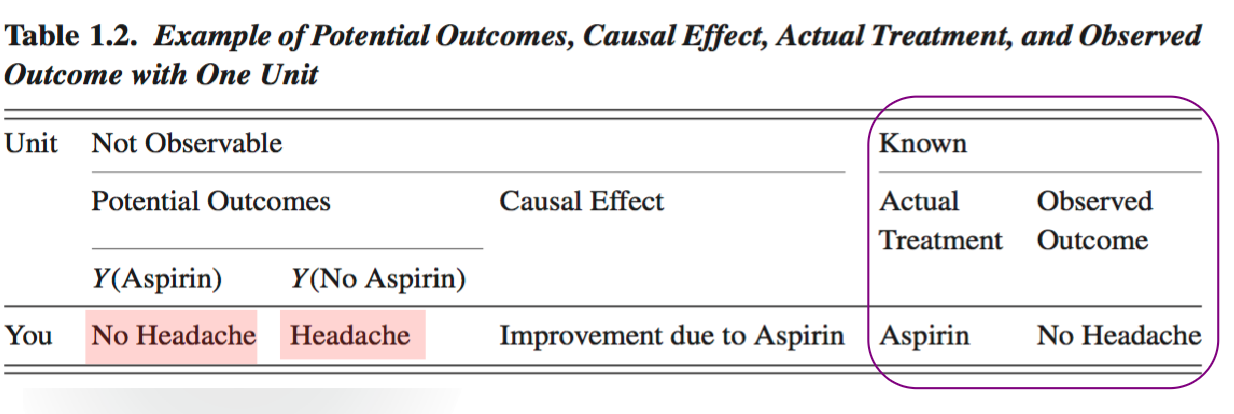
For each unit, we can observe at most one potential outcome under the realized treatment assignment.
Note that . That is saying, given the unit and treatment, the outcome is defined without randomness.
As we said before, the potential outcome is just an ordinary mapping, which can be interpreted as "the mechanism of the world". The randomness comes from the treatment (action).
We should separate the mechanism and randomness.
Then how can we do causal inference?
- Same object at different times
- Different objects at the same time
These two means both have their own issues. Here we talk about one of the issues of the later one.
Suppose there are two units, you and I. Actions are taking aspirin and not. Potential outcomes are headache and not. Then there are four parallel universes:
- You take, I take
- You take, I don't
- You don't, I take
- You don't, I don't
And if we can travel among these universes, we can have up to six () different comparisons to get unit-level causal effects.
That's way too complex, so an assumption is made to simplify this.
Assumption 1.1 (SUTVA)
- No interference: the potential outcomes for any unit do not vary with the treatments assigned to other units.
- No hidden variations of treatments: for each unit, there are no different forms or versions of each treatment level, which lead to different potential outcomes. This makes the notations such as well defined.
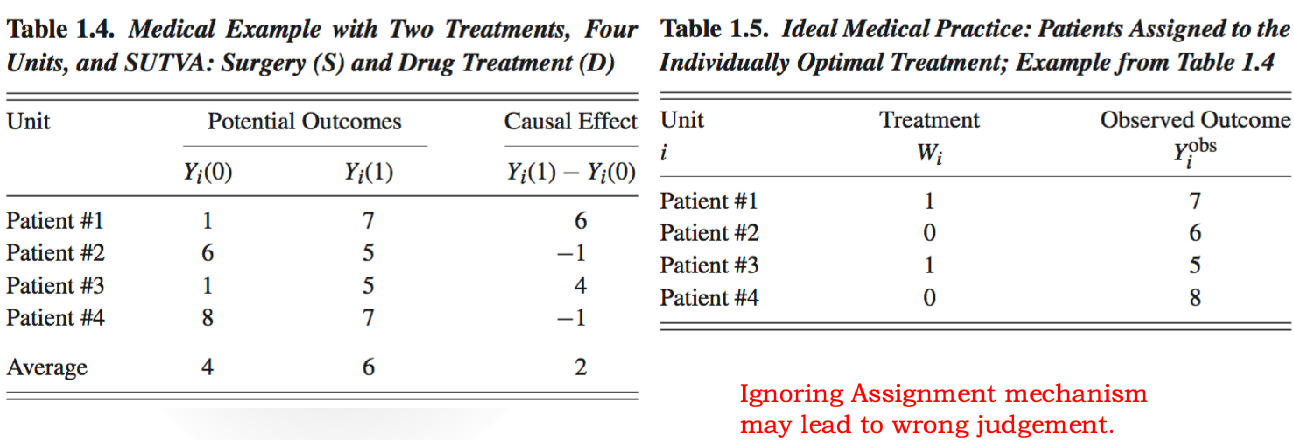
With this assumption (specifically, the upper half), the scene above can be simplified. Originally there are four potential outcomes for a specific unit and now there are only two. Therefore, to get a unit-level causal effect, we only have one () comparison.
is definite, no randomness? That is saying if I take the medicine, I am definitely gonna get rid of my headache. That's weird. Later we will allow randomness in potential outcomes, like
Assignment Mechanism
Example: Lord's Paradox
A large university is interested in investigating the effects on the students of the diet provided in the university dining halls and any sex differences in these effects. Various types of data are gathered. In particular, the weight of each student at the time of his arrival in September and his weight the following June are recorded.
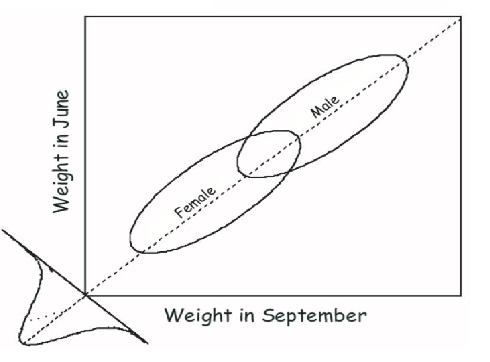
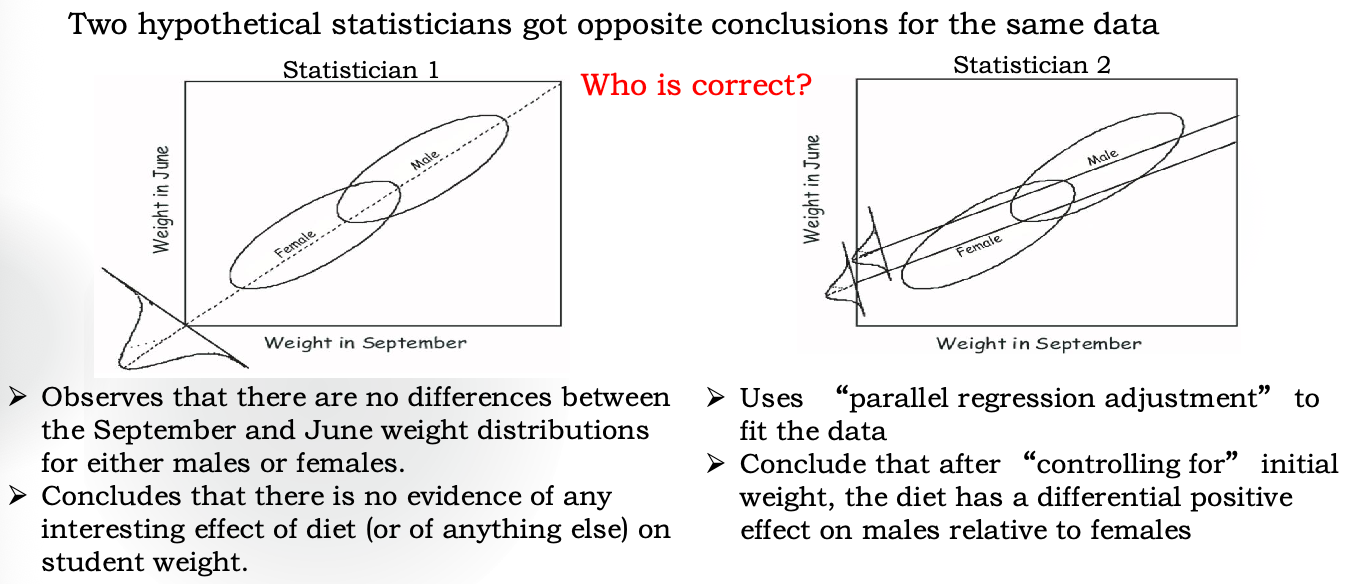
Let be the weight in Sept., the weight in June. Then one is saying
the other is saying
Both were right, but neither statement, by itself, is a causal estimand in the Neyman–Rubin framework.